
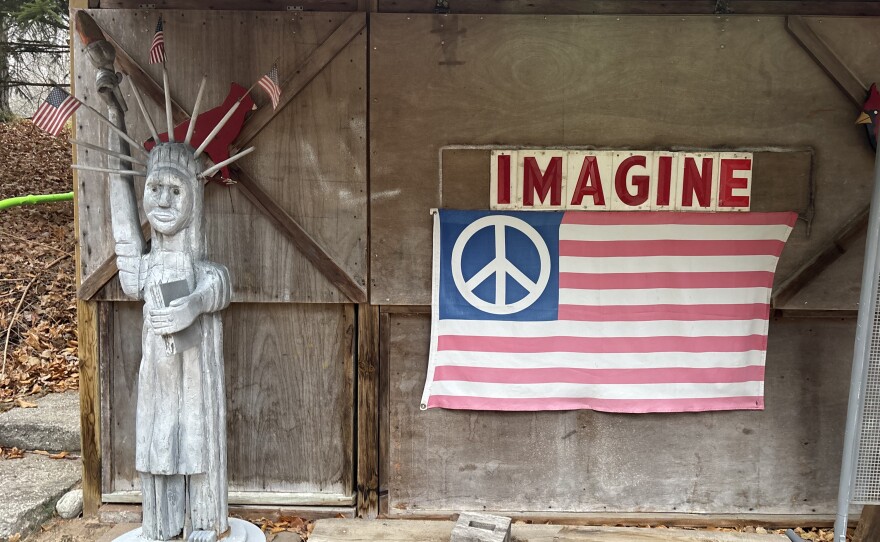

Just off a quiet road in Beulah, tucked among the trees, visitors might spot an unexpected scene: folk sculptures of Abraham Lincoln, the Statue of Liberty, and even a UFO suspended ten feet in the air.
What: A collection of Dewey Blocksma's artwork "Roundtable" on view at the Dennos Museum
When: Until January 4, 2026
Where: 1701 E. Front St, Traverse City, MI 49686
Behind these roadside curiosities sits a house on a hill — the home of artist Dewey Blocksma.
Right now, Blocksma has a show at the Dennos Museum called “Roundtable” which is now on view until Jan. 4.
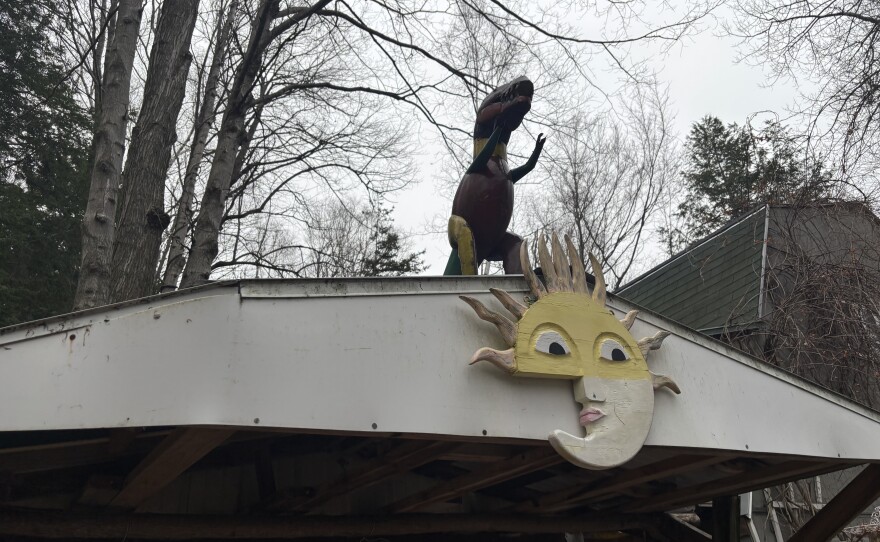
Outside his home, Blocksma pointed out sculptures in what he calls his roadside attraction. Many are his own work, but some are collected from other artists. He pointed to one he especially likes.

“He is a T. rex that's standing on a surfboard,” said Blocksma, “and he's taking a selfie. I collect T. rexes just because they're just incredible.”
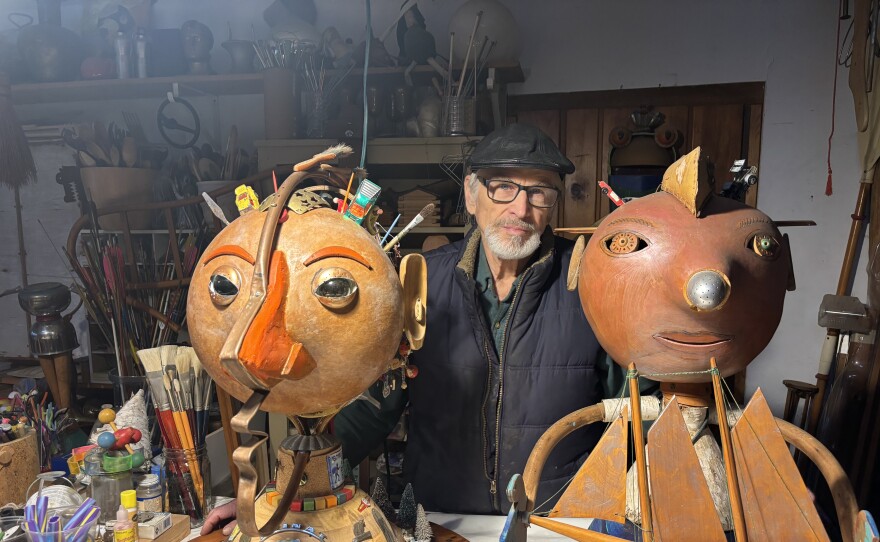
Blocksma is a folk artist who works almost entirely with found materials: toy cars, jello molds, recycled tomato cans — and sometimes gourds.
Inside his workshop, he spun one of his gourd sculptures into view. It had glass eyes, a long curved pipe for a nose and hair fashioned from paintbrush bristles.
On a tour of his property and home, it became clear that “crammed with art” didn’t quite capture the scale. Everyday objects are transformed, Beauty-and-the-Beast style. A lamp becomes a whiskered cat with bared teeth. A cello becomes a woman holding a dove.
And toys are everywhere — on bookshelves, corners, workbenches.
“I didn't have toys growing up,” said Blocksma. “It's another link to why toys became important to me. I had to make my own.”
When he was 5, his family moved from the Midwest to the mountains of Pakistan — the western range of the Himalayas — where his father worked in a hospital as a medical missionary surgeon.

“He had been through the second World War and he'd been with Patton's Third Army when they liberated Buchenwald,” said Blocksma. “He felt he had to do something with his life.”
The family returned to the United States when he was eleven, settling in Grand Rapids. Following in his father’s footsteps, Blocksma became a surgeon himself. He worked in emergency rooms and like his father traveled to give aid abroad.
“I was able to work in a little hospital in Lake Victoria and I worked after an earthquake in Peru,” said Blocksma. “So I tried to, in a much smaller way, kind of follow in his footsteps. [But] it's pretty clear that, as they say, nothing grows under a great oak tree. I was never going to be my father and I finally figured out I had be myself.”
Blocksma had worked as a doctor for about eight years, but ultimately he decided didn’t want to work in medicine anymore.
“It was partly burnout,” said Blocksma. “When my particular stint — four to midnight — was over, I would collect some of the patients who needed to have their wounds sewn up. Because my father was a plastic surgeon, I enjoyed sewing up wounds but pretty soon I began falling asleep on the way home and had to stay in motels.”
A turning point came in an art class. A friend noticed a piece Blocksma had thrown in the trash and brought it to a gallery.
“They said, ‘Wow, this looks like art,’” said Blocksma. “And then I was off to the races.”

In a lot of ways, it was a very different kind of work.
“Medicine requires you to be the mediator between the scientist and a clinical situation,” said Blocksma. “There are ways in which you have to kind of objectify your patient in order to help them. Well, in the art world, you need to make mistakes. You need to react on an emotional level. You need to take chances.”
But in other ways, throughlines cross between his work in art and medicine.
In medicine, Blocksma was guided by the altruism of his father. To help and to heal. And in his art, he’s guided by another larger-than-life figure.
Mixed in with the Blocksma’s roadside attractions are two larger sculptures of Abraham Lincoln, each about 10 feet tall.
‘I feel like we all need to listen to Lincoln no matter what perspective we have,” said Blocksma. “So I keep trying to listen to him by making sculptures about him.”
Blocksma makes small sculptures of Lincoln, too, often putting hidden pieces of the 16th president in shows. At his current show at the Dennos Museum Center, Lincoln appears inside a drone.
“He's going to hover over the White House. He's going to hover over Yosemite and California, and he's going to give us his second opinion,” said Blocksma. “And that's kind of a joke about medicine. In medicine, when you worry about something, you go get a second opinion. Well, I'm depending on Lincoln to give us a second opinion.”


