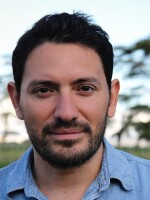
EYDER PERALTA, HOST:
For most of his life, Ken Salazar has had the border on his mind. His personal life and political career have been marked by it. A fifth-generation Mexican American, Salazar grew up in Colorado, on land that used to be part of Mexico.
KEN SALAZAR: Today about 50 million Mexican Americans live in our country. Some came to the United States after the war with Mexico, riding the ebbs and flows of labor needs and shifting migration policies. But other Mexican Americans have been here for a long time, like those whose ancestors founded the nation's oldest state capital, Santa Fe, long before the Puritans landed at Plymouth Rock. The lives of Mexican Americans are deeply rooted in stories of struggle, marginalization and the triumph of the American dream. I am from one of those older families. I am Mexican American, and I am proud of it.
PERALTA: Salazar's new memoir, "Borderlands: My Fight For An Inclusive America," traces his life from going up in southern Colorado to a distinguished career as a U.S. senator, secretary of the interior, and U.S. ambassador to Mexico. Ken Salazar joins me now from his ranch in Colorado. Good morning.
SALAZAR: Good morning. Buenos dias from the San Luis Valley.
PERALTA: So, Ambassador, you write in your book a lot about your ranch. Tell me what makes it so special.
SALAZAR: It's here at the headwaters of the Rio Grande, known as the Rio Bravo in Mexico. And it's just a special place. It's where my history has been now for over four centuries. It's part of what has defined my life in public service and the continuing purpose now set forth in "Borderlands."
PERALTA: So you identify your family's long history in the land you grew up in with the famous saying, we did not cross the border. The border crossed us. And you describe in your book, your family's journey to reacquiring lands that had originally been theirs. Why was that project so meaningful to you?
SALAZAR: You know, it's about roots. I think everybody is entitled to know who they are and where they're from. Well, I have a very proud history. It's also been a painful history where, you know, our people, my ancestors, were basically part of the conquered people by the United States in the war between the United States and Mexico. Under the Treaty of Guadalupe Hidalgo, they had the rights to stay here and their lands to be protected - most of it was not honored. And so part of my history has been to make sure that people don't forget that history. Because I think only when people understand it, now in 2026 and beyond, will we be able to really create a united America and a much more understood and closer relationship between the United States, Mexico and Canada.
PERALTA: You open the book with what I think is a very provocative idea. You call the war against and conquest of the original Mexican Americans and the land on which they lived one of the three American original sins. The other two being slavery and the genocide of Native Americans. Can you explain what you mean by this and why you think the three are connected?
SALAZAR: It all had to do with the movement on slavery and manifest destiny. You know, Abraham Lincoln, as a member of Congress, was vehemently opposed to the war, and he said it so in the famous speech that he gave on the floor of the House of Representatives. It was a war that was provoked/created in order to be able to acquire what became 55% of the then Mexican territory swallow the Southwest. Because the relationship was one born of war, there were - almost a hundred years passed before president of the United States went to Mexico City. And so the relationship is still very much defined by the repercussions and the consequences of that war.
PERALTA: In 2021, you're sort of thrown into this long history between Mexico and the U.S. when President Biden appoints you ambassador to Mexico. And that's a moment when immigration seemed to be the most pressing issue. What was happening at the border at that time?
SALAZAR: The border was in crisis, as it had been and still is today. I went there to transform the relationship forever - made great strides on the substantive agenda, both in the U.S. and Mexico. We became the No. 1 trading partners in the history of humanity. We move forward with efforts to try to create joint projects along the border, with regional efforts on migration flows in the summit that we had in Los Angeles.
But we did not get it across the finish line - first, because the Republican opposition led by Donald Trump wanted to keep the border as a point of crisis and migration as a point of crisis because it would benefit his political goals. And secondly, on the Democratic side, the Americas are not a priority in their foreign policy. And when that happens, you can't address these very, very difficult issues of migration, a broken border. You just can't do it unless you create a strong priority from whoever is president of the United States.
PERALTA: But you do push - in your time as ambassador - you do push a policy, right? You call it the curtain of security to try to control migration. What was it? And why did you think it would work?
SALAZAR: So the president of Mexico, Andres Manuel Lopez Obrador, was very focused on the southeast of Mexico, what he calls the rincon olvidado. One of those areas was a narrow Isthmus of Tehuantepec, and that was a place where Mexico was investing billions of dollars. So I tried to get Washington to very much focus on it, but we couldn't get enough of a priority for it within the executive branch.
But that's where the solutions really lie. They lie - yes - on our border, the 2,000-mile border, but they lie to the south. They lie in creating new and modern border between Guatemala and Mexico because, effectively, there's no border there. And then the borders across the land bridge of the - Central America - they basically do not function. And so we, the United States, could help lead the effort to creating border security across those countries that ultimately would create security here for the United States.
PERALTA: So I cover Mexico, Ambassador, and I saw this policy in action, and I think that's not really what I saw. What I saw was Mexican authorities were essentially tasked with putting migrants through a gauntlet. When migrants made it to the U.S. border, they weren't deported to their home countries. They were flown or bused to southern Mexico. They were often left in the middle of nowhere. Mexican authorities often separated families. You talk a lot about the values of the U.S. and its responsibility to welcome migrants. But you pushed this policy, and this is how it played out on the ground. Don't you think it was hypocritical?
SALAZAR: What we tried to do was to connect people up to the labor force - so H-2A visas and other legal ways to get to the United States. And so if you were, for example, in the asylum system, you were looking to get refugee status, you'd have a safe place, and we were standing up these spaces in Guatemala. It'd be a hell of a lot better to get your refugee application and status through those mechanisms, as opposed to taking this 1,500-mile journey to the north.
PERALTA: I mean, at the same time, the moment we're in right now, you have a United States that threatens to bomb Mexico. You have a Trump administration that embraces the revival of the Monroe Doctrine - he calls it the Donroe (ph) Doctrine. What do you think when you hear that coming from the American president?
SALAZAR: You know, it's taking the United States back, and its foreign policy to another time that is a very frightening time, but it's not the American way. I think the United States is awakening. I mean, I've traveled around the country and everywhere I go, there's great enthusiasm for our country, for who we are, how far we've come, how much we have to still undergo to get to a better, more inclusive America - but also rejection of where Donald Trump is taking our country.
PERALTA: That's Ambassador Ken Salazar. His new memoir, "Borderlands: My Fight For An Inclusive America," is out now. Ambassador, thank you.
SALAZAR: Thank you, very, very much, and hopefully we'll see you in Mexico before too long.
(SOUNDBITE OF GILBERTO PUENTE'S "MI CIUDAD") Transcript provided by NPR, Copyright NPR.
NPR transcripts are created on a rush deadline by an NPR contractor. This text may not be in its final form and may be updated or revised in the future. Accuracy and availability may vary. The authoritative record of NPR’s programming is the audio record.